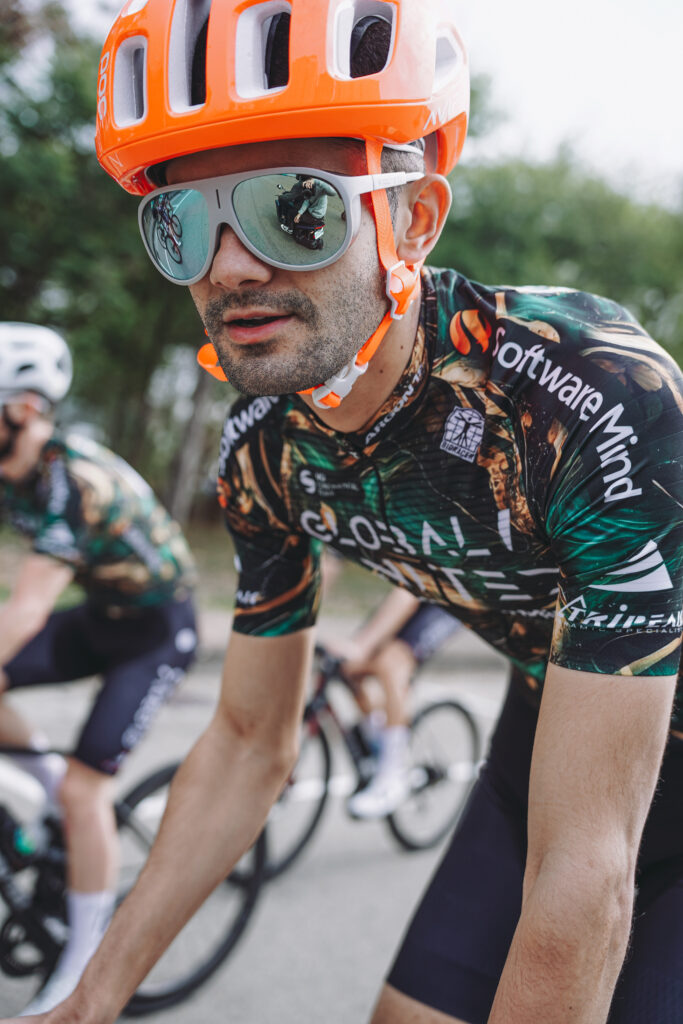
Ask any professional cyclist where they spend their January and February, and a significant number will say the same thing: Mallorca.
The island’s roads have been ridden by virtually every rider of note in the modern peloton. The reasons are well understood: exceptional climbing, reliable winter sun, minimal traffic on the mountain roads, and a density of outstanding routes within a compact enough geography that a serious training block doesn’t require endless transfers. For amateur cyclists and cycling enthusiasts, those same qualities make Mallorca’s roads among the most rewarding riding available anywhere in Europe.
Sa Calobra: The Climb Every Cyclist Should Ride Once
Sa Calobra is, by any measure, one of the most extraordinary roads in the world. The descent from Coll dels Reis spirals 882 vertical metres to sea level across 26 hairpins — including the Nus de la Corbata, the famous 270-degree loop where the road coils back under itself in a feat of engineering that seems more improbable the first time you see it than any description can convey.
The numbers: 9.2km, average gradient 7.1%, maximum 10%, 882m elevation gain. Ridden from the top, the descent is one of the most technically demanding and visually spectacular in European cycling.
How to approach it: Best ridden early in the morning before the tourist coaches begin. Descend first, then climb — the ascent rewards careful pacing, with the final kilometre significantly steeper than the lower slopes suggest. Most riders take 45–55 minutes to climb; those who have ridden it before know to keep something in reserve for the last 3km.
Cap Formentor: Mallorca’s Most Dramatic Headland
The road to Cap Formentor — 20km of pine-lined tarmac running from Port de Pollènça to the lighthouse at the island’s northeastern tip — is the kind of route that justifies travelling specifically to ride it. The views from the Mirador del Mal Pas, where the road clings to a cliff above an impossibly blue sea, are among the most photographed in the Mediterranean.
The numbers: 20km to the cape, relatively rolling with approximately 600m cumulative ascent. Several rises are steep enough to demand attention; the return gives back most of what the outward journey took.
Local knowledge: The road is closed to private vehicles during certain summer hours, which actually improves the cycling experience considerably. The Hotel Formentor, roughly halfway along the peninsula, has one of the finest terraces for a coffee stop on the island.
Coll de Sóller: The Classic Tramuntana Crossing
The Coll de Sóller connects Palma to the Sóller valley via a sustained climb through the heart of the Serra de Tramuntana. At 496 metres, it isn’t the island’s highest pass, but it’s consistently regarded as one of its most satisfying climbs — long enough to demand respect, technical enough to reward good position and pacing, and beautiful throughout.
The numbers: 7.5km from Bunyola, averaging 5.5% with maximum gradients of around 9% in the upper section. The descent into Sóller is one of the finest on the island: fast, technical, and delivering you into one of Mallorca’s most beautiful towns.
The Puig de Randa: Mallorca’s Quiet Climb
While Sa Calobra and the Tramuntana passes draw the majority of cycling attention, the Puig de Randa — an isolated limestone massif rising 543 metres from the flat agricultural interior — offers something different: a short, sharp climb through three ancient monasteries, extraordinary views across the entire island, and roads that see a fraction of the Tramuntana traffic.
Best included as: part of a longer ride through the Pla — Mallorca’s flat interior. The Pla rewards unhurried riding through villages, almond groves and vineyards, with the Puig de Randa providing the climb that punctuates and rewards an otherwise meditative day’s riding.
The Tramuntana’s Hidden Roads
Mallorca’s most celebrated routes are exceptional. But the island’s most rewarding riding often happens on roads that don’t appear in standard cycling itineraries: the descent from Orient towards Alaró, the approach to Galilea through the vineyards of Santa Maria, the loop through Deía and Valldemossa that captures the full visual drama of the Tramuntana’s coastal escarpment in a single afternoon.
These are roads that reveal themselves over time — and over multiple visits. They require local knowledge not just of the routes but of the conditions: which roads are open in winter, where the morning sun reaches first, which descents become treacherous when the tramuntana wind picks up from the northwest.
At ALTIVELO, exploring those roads — the famous ones and the hidden ones — is what every private cycling experience is built around. If you’re coming to Mallorca to ride, come to ride it properly.